

why space exploration doomers keep having public tantrums
Jason Pargin joins a growing list of sci-fi authors growing despondent over how hard it is to explore space in real life.

Usually, I find Jason Pargin to be a thoughtful, nuanced writer when it comes to his opinion pieces. I may not always agree with his points, but have to admit that there’s logic and internal consistency applied when crafting his arguments. Which is exactly why his viral polemic declaring that interstellar travel will never, ever be possible, and summoning dragons is more realistic, left me scratching my head.
Now, to get this out of the way, I am not here to argue that interstellar travel is on the horizon and will be possible sooner than we know it because progress. Science and technology don’t work like that, and there is no guarantee we’ll ever make it work. At the same time, declaring that a technology will never be invented and anyone who is even the slightest bit optimistic is a delusional hopium addict, is equally ridiculous.
Pargin’s essay essentially boils down to the fact that space is vast, we don’t have an actual, promising design or prototype for a warp drive, and sci-fi novels have to make faster than light travel work with the magic of technobabble, therefore, we’re stuck in our solar system now and forever, the end. But don’t take my word for it. Take his.
First of all, it turns out that the ships in Star Trek, Star Wars, Dune etc. are not based on some kind of hypothetical technology that could maybe exist someday with better energy sources and materials (as I had thought). In every case, their tech is the equivalent of just having Albus Dumbledore in the engine room cast a teleportation spell.
Uh… Yeah. Of course science fiction authors don’t have a plausible mechanism for a faster than light drive because if they did, they’d be busy getting Nobel Prizes while securing billions in funding. People are fully aware of this, so the Venn diagram of sci-fi fans and people who think interstellar travel is possible because dilithium crystals are real, or there are Goa’uld Stargates in the Arctic are two horrifyingly mismatched circles that barely touch each other in a psychiatric facility.
It’s not even a new concern. Anyone who knows anything about space is aware that given current technology and funding levels, it will take us tens of thousands of years to get to our closest stars and we might launch by 2697 at best. At the same time, we also know we have much better technology we are either keeping on a shelf because tax cuts for billionaires are more important, or we’re still trying to develop it. Pargin is explicitly consigning all of these technologies into the realm of “space magic.”
to warp, or not to warp, that is the question
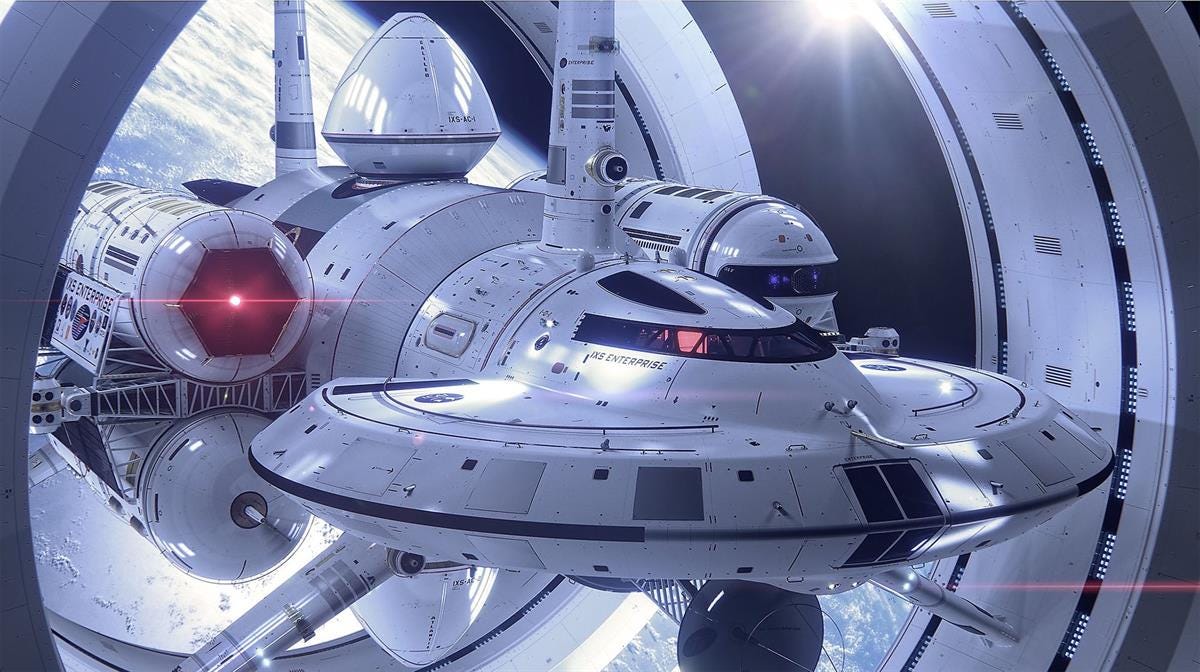
This is a pretty common pessimistic approach to the problem, with the more technical version of this criticism focused on mining the glaring shortcomings of the Alcubierre drive, which provides a mathematical basis for spaceships that bend the fabric space to travel faster than light, but requires negative mass — which has been made in a lab as a superfluid — and more energy than the universe as we know it contains.
Sure, that doesn’t work as a practical solution, but Alcubierre knew full well he didn’t figure out warp travel. His goal was to lift an informal taboo on taking the idea of real, working warp drive seriously, and get other physicists involved. Since 1994, they’ve found models that don’t require exotic matter, and rather than consuming the mass-energy of entire universes, need the equivalent of 700 kilograms of antimatter.
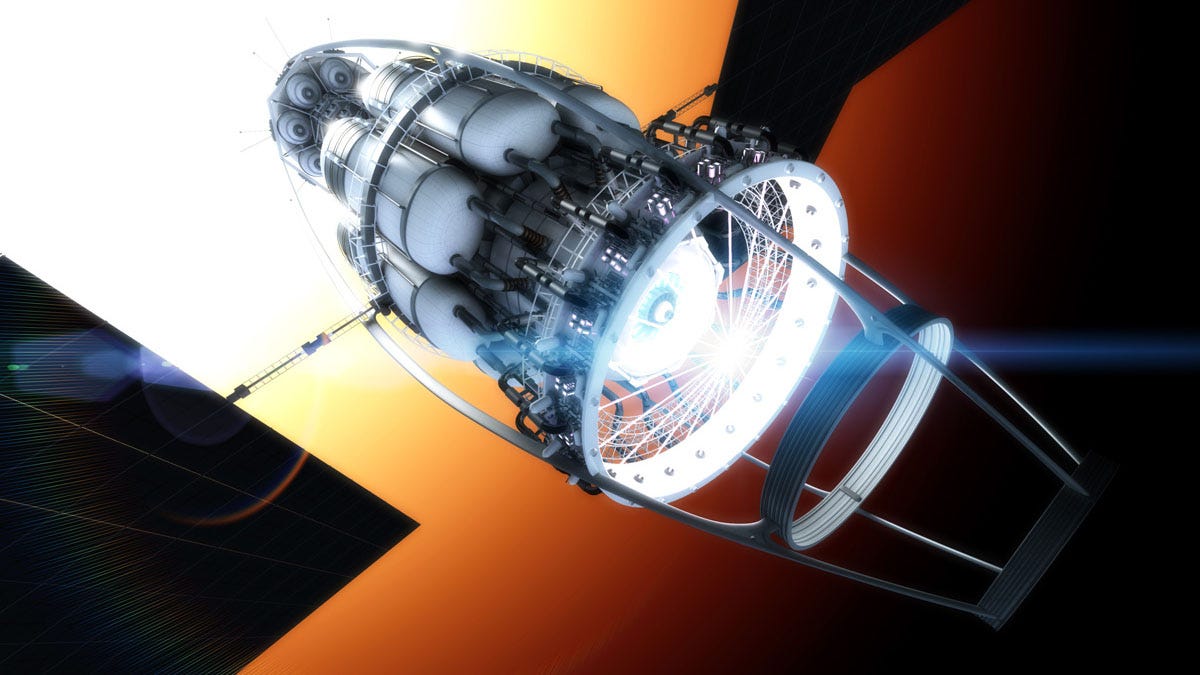
Yes, it’s still a lot, but a Caterham Seven EV’s worth of antimatter is a whole lot less than the entirety of the cosmos and then some, and is theoretically plausible. Today, we can make 15,000 atoms of anti-hydrogen in seven hours, meaning it will take 28 sextillion years to hit 700 kilograms. It sounds discouraging, but consider that it took over ten weeks to produce the same amount of antimatter back in 2018, while in the late 2000s, you’d be excited to create a few hundred atoms in one experiment.
On top of that, it’s not the scientists’ goal to manufacture antimatter on an industrial scale in these experiments, but to use what they have to create material to study as quickly as possible. An actual antimatter factory wouldn’t just be a scaled up CERN device, but a completely different design. And this is just what we’ve learned in one-off experiments on relatively shoestring budgets. Which brings us to this quote…
[ ... ] it seems like if you had two agencies with infinite budgets, one dedicated to developing interstellar space travel and the other dedicated to giving a young child all of the magical abilities of Harry Potter, the latter would get to the finish line first.
We just covered that on the tiniest excuses for a budget, scientists are coming up with all sorts of potential solutions to the problem of interstellar and faster than light travel, so if you gave them a blank check for however long they need, we’d immediately see dozens of experiments, simulations, and prototypes to test every possible idea which will help us discover new physics and come up with new solutions.
Surely between synthesizing antimatter, figuring out a workable form of fusion, taking advantage of special relativity and time dilation, and lasering the quantum crap out of atoms at near absolute zero to create magnetic Bose-Einstein condensates, scientists and engineers unleashed to work on their wildest dreams could come up with all sorts of interesting ideas, rewriting entire disciplines in the process.
full of sound and fury, signifying nothing
I found it interesting that the criticism of interstellar travel Pargin cites in his preamble comes from angry sci-fi writers whose essays are best summarized as them angrily processing that we don’t have interstellar spacecraft on the horizon and are unlikely to have them in their lifetime, therefore dreams are for idiots and there is no way this is ever happening. In other words, those grapes are awfully sour and it’s their solemn duty to inform you that you will never taste them either.
Actual engineers and scientists are significantly more interested in figuring out how to solve the many challenges involved before doing their best impressions of Eeyore and telling us to just sit down and give up. Or, like Pargin, veer off into what I can only call performative absurdity with a statement like this…
… If a civilization has successfully developed the technology to make interstellar travel reliable, common and comfortable, then it by definition is at a level of tech where an average citizen could (for example) buy a “wand” that can summon an object out of thin air, make it levitate, then instantly teleport it and the user to another location.
Huh? The only things that warp drives, reliable long haul spacecraft, 3D printing, and teleportation have in common is that they’re advanced concepts often mentioned in the same breath. It’s the equivalent of “if we build airplanes that fly faster than sound, why can’t I walk through walls?!” Probably because relativity, chemistry, and quantum mechanics are different disciplines, so much so, their theoretical underpinnings don’t fit into each other when it comes down to their most fundamental levels.
So for everyone replying that this is all doomer pessimism because science is constantly bringing into reality wonders that were previously seen as magic, how would you respond to a teenager saying she wants to be a dragon rider when she grows up? If anything is possible, why not that?
The only person saying that anything is possible is Jason, who spends the entirety of the essay throwing wild haymakers at strawmen. Except he didn’t even really bother to construct the strawmen, so they’re more just piles of straw being blown about by a breeze as he tries to swing at them.
All of this ultimately brings us to a sort of bizarre meltdown over the fact that no, Star Trek isn’t real and we all know this, but a lot of people told him it would be real, and it should be something of a goal for society to become a utopia where humans explore the galaxy with the same ease we travel to the next town over, and turns out it would never be like that, therefore, fuck you and your stupid dreams of space travel.
how to turn readers into unwitting therapists
The more you read this essay, the less it seems like a deep dive into the challenges of space exploration and more like you’ve been recruited to somehow help Pargin cope with the fact that Star Trek was a TV show and a relatively old and low budget one at that, which is why spacecraft had gravity and small apartments, every planet was like SoCal, and every alien spoke English and looked like a regular human in experimental atompunk clothing wearing a prosthesis or painted green.
He almost seems angry at being told that being explorers is our future and we should strive to see beyond our solar system as a species. Why is that a bad idea? We could argue that it’s this end of exploration, the age of forced self-domestication for what’s nothing more than the glory of consumer capitalism for its own sake, is partly why we are as restless as we are, while having as many creature comforts as we do.
Just because a goal is immensely difficult doesn’t mean it’s not worth it in the end. He is right that in a thousand years there will still be humans on Earth. Hell, we’ll be here in 30,000 years too because this is our home world and hopefully, all the things we’re able to learn in becoming a multi-planetary, then interstellar species will come back in the form of hugely beneficial technologies and discoveries we can use to make Earth better in every conceivable way.
In the process, we would also change. Humanity as we know it today won’t make it to the stars. But our genetically and cybernetically enhanced descendants just might. In creating them, we will also learn how to treat more diseases, fix more injuries, improve quality of life, extend lifespans, and who knows what else. We have tens of thousands of pretty sound ideas for further study. If we had the aforementioned infinite budgets, the advancement we’d be able to implement are truly mind-boggling.
Yet the catch is that we have to actually do this work. The idea that “everything sucks and is impossible, and it’s stupid to even think this will ever happen” is a great way to throw a tantrum that you don’t live in a sci-fi utopia now, but poison to attitudes which decide what scientific and technical advancements get to see the light of day. If we’re ready to give up before we even try, then what’s the point of anything?
This is why essays like Pargin’s should not be treated as “necessary tough love from a realist,” because that’s not what they are. They’re a tantrum from the disillusioned. As they learn that they may never live to see their dreams come true, they want us to lay down on the floor with them and mourn as we discuss exactly how horribly sour those space grapes on Epislon Eridani no one will ever, ever taste are.
Our response should be to try anyway, even knowing there’s a nonzero chance that we may fail. What else are we doing with our time? Wallowing while we watch Netflix and dream of better days we were denied by aging bureaucrats who still think we live at the dawn of the Industrial Revolution and Dickensian Britain is peak civilization? I’d rather try something to move the needle forward, even if it is just out of spite and for a pretense of hope. Sure beats cataloguing the things we’ll supposedly never do.