a marauding star vs. our solar system
A rogue star passing through our stellar neighborhood could cause the biggest mass extinction since the Permian in 1.5 million years. Or it might not. We still have to see.


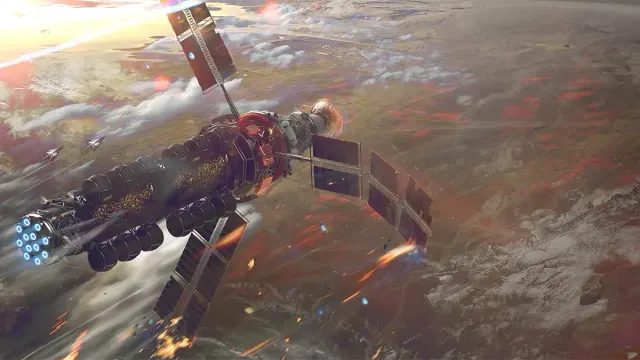
Imagine a speeding star plowing through the Oort Cloud surrounding our solar system and sending a stream of comets towards the Sun, a number of them smashing into Jupiter or diverted by the Jovian gravity into the inner solar system where the Earth could easily careen into them. The impacts could easily cause the kind of mass extinctions experienced by the dinosaurs. It would be sudden, brutal, and a significant percentage of the planet's flora and fauna could be wiped out within weeks.
No, this isn't just another doomsday scenario in the spirit of the 2012 mythos, but the implications of a study which used the Hipparcos Star Catalogue to plot the motion of stars within a 98 light year radius of the Sun and found that an orange dwarf named Gliese 710 has an 86% chance of triggering the aforementioned chain of fiery and deadly events in about 1.5 million years.
Unless you've figured out the secret of immortality, you probably don't have to worry about something that may happen over such a long stretch of time and as pointed out by Dr. Ian O'Neill on Discovery Space, the human species might not even be around that far in the future. And the odds of Gliese 710 actually brushing the Oort cloud, disturbing the nuclei of large, icy comets could change as we get more and more data.
Since the star catalog used for the study's models was completed in 1997 and newer probes with far better instruments are known for helping to revise older data, we can't rule out that a few decimal points off here or there may change the entire outcome. Even a slight change in the data projected over hundreds of thousands of years can yield very different statistical models. In addition, the study's author, Vadim Bobylev, focused on stars that would be about 7 light years away from the Sun or less. Considering that the closest solar system is just a little over 4 light years away and we're not being pelted by comets today, just how close and disruptive Gliese's 710's flyby will be is still a somewhat open question.
The marauding dwarf sun could send comets bouncing into each other, out of the solar system, or into Kuiper belt objects rather than towards us. What would happen depends on a myriad of factors which include everything from Gliese 710's speed and angle, to the layout of the section of the Oort Cloud by which it should pass. There could be a much greater potential for something destructive if the rogue star wanders into the Kupier belt itself and affects dwarf planets or very large asteroids, but the odds of that happening are far, far less, about 1 in 1,000. And let's keep in mind that there's a 14% chance that Gliese 710 will miss our solar system altogether and its orbit may change as it flies through our stellar neighborhood…
See: Bobylev, V. (2010). Searching for Stars Closely Encountering with the Solar System Astronomy Letters, 2010 Vol. 36, №3 arXiv: 1003.2160v1