how nihilism became pundits' favorite scapegoat
Across media, both social and legacy, commentators bemoan nihilism as the force that got us into today's mess. It's not.


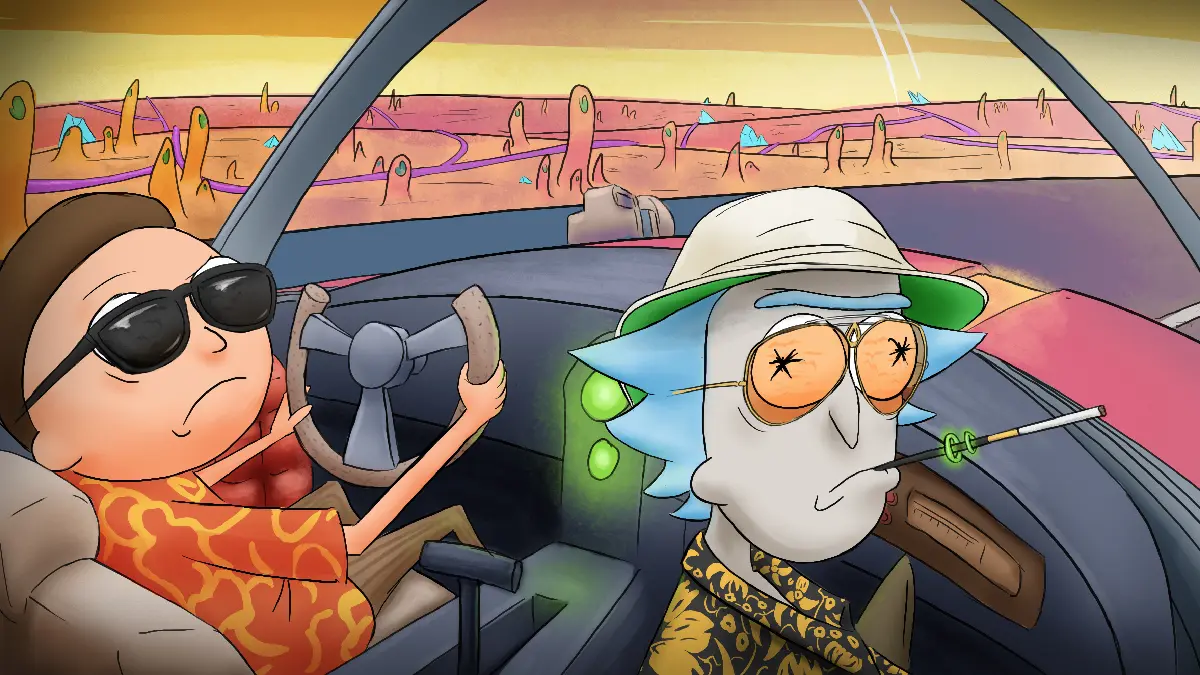
Illustration from Rick and Morty, S4:E2
When anyone brings up nihilism, it's usually to decry it as a corrosive, evil, and destructive mindset rotting society and enabling our decay. This is why you'll find plenty of articles blaming it for the stupid cyberpunk dystopia we're being forced to build for ourselves. Take this essay by internet culture writer Charlie Warzel and you'll find the familiar trope: when nothing really matters, people turn into crazed hedonists as if possessed by Slaanesh, dragging us all down with them "for the lulz" in meme format.
But what if I were to tell you that nihilism is a perfectly viable philosophy which implies none of this? It's just an alien idea to most people because we're always told about some great arbiter of morality ready to judge us for our sins and that we're all born with some special purpose, a part to play in this world, and all we need to do is discover what it is to feel complete. All nihilism says is that this is almost certainly not true. And to some of us, that's incredibly freeing.
Let me try and explain it this way. Consider the most common nihilistic phrase we've all been taught to fear: nothing really matters. Imagine it said with a deep, pained frown. Nothing you do matters, nothing really means anything, no one is waiting for you to go on some hero's quest to discover yourself and set the world right, and there's no special place in the universe you fill. Sounds horribly cold, empty, and impersonal, doesn't it?
Now, imagine it said with a smile, going from "nothing really matters 😕" to "nothing really matters 🤣" and trying to genuinely mean it. Because if nothing really matters, you're free to make your own choices. You are not defined by your place in the universe, which you'd have to find while living up to a social contract we've all seen is entirely arbitrary and held up by nothing more than a handshake and a pinky swear. Your purpose is your own to choose, you belong where you feel most at peace, and your moral code is your own conscience.
To borrow from a common atheist quote, I don't need a book or a priest to tell me not to steal, or rape, or kill. I don't want to do any of those things. If I have to hurt someone, it's going to be in self-defense. If I want something, I will either pay for it or figure out a way to win it or barter for it because I don't like when my stuff gets stolen and I imagine no else does either. If I have sex with someone, it will be with enthusiastic consent because, well, what's worse than violating someone's right to bodily autonomy and making their own choices?
Nihilism doesn't say "eh, who gives a flying monkey fuck, do whatevs." It says that you will be judged by your conscience and those your actions affect. You haven't been "tempted into sin" or "let the Devil into your heart" if you did something bad or hurt someone. You're just a shitty person and your punishment is to know that you are a shitty person other people are going to hate for the shitty things you did. There's no soul to save or grand moral authority to appeal to get a clean slate. You just have to sit there in your failings.
This doesn't mean I have no accountability just because I don't think there's some special place in the universe for me, or some grand order of life I must follow. It's quite the opposite, really. I'm accountable to everyone with whom I interact and everyone who my actions affect. Just see The Good Place for a full argument of how it unfolds because even though the events take place in the afterlife – mostly Hell, Limbo, and the meta plane – it still tackles this very problem.
Instead of proclaiming that a god or some eldritch cosmic deity will judge me, I have more than a thousand judges at any given time and their decisions matter, not just in an afterlife, if there's even such a thing, but now. In a way, while most religiously inspired philosophies say "you must follow the path of the light!" while clutching a book, nihilism takes a long swig of beer, cackles with a sinister smirk, and says "no, no, go head, fuck around, see where that gets you."
And that's where for some, that key phrase of nihilism suddenly becomes "nothing really matters 😈" since they either severed their conscience, decided to ignore it, or just never had it in the first place. It's not that they embraced a philosophy that says human life isn't special and precious but a lucky accident and there's no big reward in the sky for being a good person. It's that they are – as we just covered not too long ago – shitty people who do shitty things because, well, they're shitty people by their nature.
They would've made shitty Christians, Jews, Muslims, Hindus, what have you. You can see Russel Brand go from being a shitty atheist to being a shitty Christian after reports of his inability to keep his dick to himself when asked to became common knowledge. Which is the other uncomfortable truth of nihilism. There is no path to divine redemption, no way to wipe your slate clean. All of your sins and misdeeds will follow you until the day you die.
What pundits like Warzel really decry is sociopathy. It's not that the people who rightfully earned their ire believe that nothing really matters, but that it's either their right, or even duty, to be society's equivalent of cancerous polyps. They make the terrible memes they do, inflict pain and misery on others, and celebrate their own cruelty with glee because of who they are as people. We couldn't have jumped in and stopped them by appealing to empathy they so clearly lack.
Hell, there are megachurch pastors who act this way, offering prayers, platitudes, and long, erudite sermons about how God has a plan for all of us. Then they pass around a collection plate, hit their congregation up for cash, hop on a private jet, go to Vegas to party until they drop, and refuse to help people who actually need the helping hand they preach. (You should just watch The Righteous Gemstones on this, it's practically a very awkward documentary.)
I get it that it's tempting to say "aha! this philosophy makes evil people" because if that was true, you have a semi-convenient enemy you could fight and beat into some sort of intellectual submission. But the problem with shitty people is that they often became shitty people first and foremost, then chose an ideology to adopt or pervert to match their hedonistic and sociopathic desires and indoctrinate other empathy-challenged people, not the other way around.
Which, believe it or not, is another lesson on nihilism. We are the problem. We can be the solution as well, but we need to choose this path for ourselves. Many of us keep choosing poorly and making it everyone's concern, and if we ever want to fix this, we need to put in the work. As we've just discussed, it's not the universe's job to do that for us. It's ours.