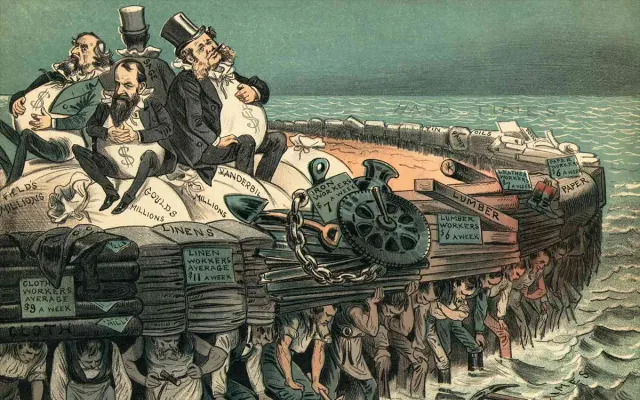
wealth, taxes, and snake oil finance
Extreme inequality caused by runaway capital gains is eating away at the global economy. But high taxes on passive income won't be a panacea.


Now, far be it for a lowly techie to question the work of an economist like Piketty since he's, well, an economist, with many years of education and research in the discipline, and since I'm not a political pundit, I don't suffer from the delusion that just being able to read his thesis makes me an expert in economics as well. But at the same time, this is the internet, I have wi-fi and years of professional blogging experience, so I'm going to barrel ahead anyways. Although it's not so much to say that Piketty is wrong in his conclusions or his views about why economic inequality is a bad thing, as much as, at least in my opinion, his proscription has a hidden danger in it and it covers up the biggest and most problematic issue for workers in the near future, for whom his solutions will fall very, very short.
At the core of Piketty's findings is the issue that capital gains are outstripping economic growth by comparison, and it's really difficult to argue with mathematics on this. The compound return on $3 million in investments is going to grow a lot faster than savings from a $45,000 per year salary socked away into secure, slow growing investments. This is especially true because the larger sum lets you better absorb market losses, and gives you leeway to be more aggressive with your investment strategies, whereas smaller investments have to be far safer, since many risks become too expensive. And so, true to the saying, the rich get richer.
But this is not necessarily a bad thing. Inequality in and of itself is a very normal condition, and even in the most egalitarian community there are those who, to paraphrase an old Soviet quip, are more equal than others. Where the problem lies is in inequality looming so wide that social mobility starts to notably suffer, something that may be starting to happen in the United States. Certainly the capitalist ethos of the U.S. dictates that there will be winners and losers when we talk about money, and that someone who became a millionaire after many years of hard work and smart asset management should be seen as an example, not an exploitative oligarch.
But at the same time, this culture was based on equality of access, i.e. the idea that we should all start with similar opportunities and through hard work, achieve our dreams. When you're no longer able to do that, the economic game becomes rigged and the consequences to long term stability are dire. Typically, nations with the biggest middle classes and the most social mobility enjoy the most stable and prosperous economies. Those divided primarily into a wealthy elite v. a small middle class and many in poverty, stagnate and suffer from more violence, crime, and political unrest. So Piketty's point that we shouldn't stand idly by, concluding that if an oligarchy emerges from a capitalistic economy we should simply accept it, has serious support behind it. But should we start taxing wealth at punitive levels to avoid an authoritarian kleptocracy?
In a short? No. Gains from investments are not certain, and even worse, if you recall the Great Recession's more boring, but financially crucial lessons, many of today's massive capital gains were built on the very shaky foundation of financial shenanigans and collaterized obligations by over-leveraged banks. Institutions borrowed so heavily to trade assets which were rotten at the core, boosting value of financial equivalents of badly burnt White Castle sliders to that of a filet mignion made by Gordon Ramsey, and then played a game of musical chairs with them. (That should be enough overlapping metaphors for one sentence, right?) And if you think the banks learned from their mistakes, you are an optimistic soul whose lofty expectations of your fellow humans is endearing, but sadly, misguided. Which is a long-winded way of saying "hell no."
So do you really want to pump whatever you could recover before it's squirreled away in some tax haven based on Wall Street voodoo into the economy and then tie government funding and basic social services to the ups and downs of some stock broker snake oil? Wouldn't it be wiser to regulate financial monstrosities into virtual non-existence and promote investment in lagging and much needed areas of the economy and education? We really want people like Elon Musk and Bill Gates to invest into medicine, science, education, space, and new technology, and we should make it easy and gainful for them to do so with tax incentives. We don't want billions to be loaned to banks that will use it to gamble on the spreads of some Hungarian foot fetish porn company stocks, or giant squid tentacle futures, we need to identify them as the junk they are, and punish those obfuscating their over-leveraged positions in overly volatile markets. Problem sort of, kind of, maybe solved in an ideal world? Well, not exactly. Stay tuned for the deep dive into how computers and robots play a big part in all this tomorrow…