when archeology meets numerology
When connecting the dots in archeology, you might end up with a discovery you think rewrites the history books. Emphasis on the "you think" part...


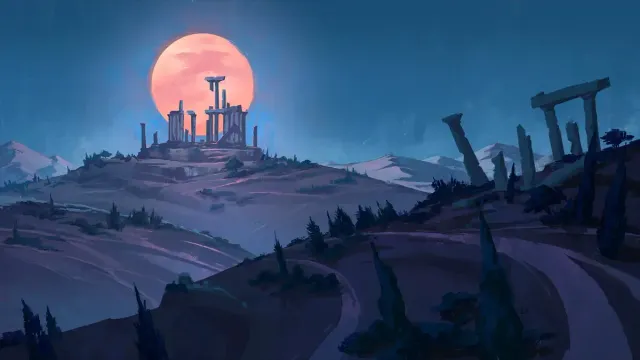
Illustration from Pac Man Archaeology by Split Reason
Numerology, the idea of scrutinizing large volumes of information to find different codes and permutations that promise to unlock the secrets of the universe, has been featured on this blog before in the example of the so- called God Equation, which tried to jam random connections between geometry, ancient megaliths and a few concepts in physics into sound proof that our planet and its Moon were designed by an intelligent entity.
And it should be pretty evident that even when a numerologist comes up with an equation that actually works and its results demonstrate a neat mathematical trick, we can't accept it as proof for some sort of grand discovery, as deliberately crafted similarities and correlations on paper just don't have the same weight as experiments and recovered artifacts that can shed light on ancient mysteries. Still, the numerologists will always keep trying…
For example, take Tom Brooks' discovery of what has been called an ancient GPS in prehistoric Britain. After a survey of 1,500 Neolithic sites, which of course include Stonehenge, he plotted ancient settlements on a map and made the conclusion that ancient Britons traveled by hilltop monuments arranged at the end points of isosceles triangle designs radiating in several directions.
After taking a brief look at the schematic produced by Brooks, it becomes pretty apparent that navigating this way would actually be quite inefficient, especially if a road with a few stones indicating how close different settlements are and in what direction would do a much better job. In fact, we still use the same idea today. We call them road signs and it's possible that there could be carved Neolithic stones buried under thousands of years worth of dirt, showing how our ancestors found a settlement before there were actual roads or satellites to establish a GPS network, much less a device able to tell them when to turn right in a lifeless, synthesized voice.
But hold on a second. How could we dismiss the lines between the ancient settlements drawn by Brooks? In his column for The Guardian, skeptical doctor Ben Goldacre did the exact same trick with a map of discount stores and came up with a very similar pattern of isosceles triangles, illustrating that what Brooks really did in his analysis was to play a game of connect the dots until he found an arrangement that looks interesting, then went to the Daily Mail with his story.
Yes, the Daily Mail, the tabloid well known for its propensity to publish all sorts of pseudoscientific junk in what it liberally calls its science section. So when you combine numerology with ancient, mysterious archeological sites and throw in some sort of reference to how ahead of the times a society that lived thousands of years ago really was, you get a popular story. What you don't get though, is any kind of actual evidence or research. Still, for some people it's hard to let a good thing go and a few Guardian readers blasted Goldacre's satire, citing the pyramids, the arrangement of Stonehenge, and Mayan pyramids as evidence that the ancients did have a good grasp on math and astronomy.
Yes, it's true that many monuments in the ancient world were precisely aligned to form certain patterns. But in the case of the pyramids and Stonehenge, we know that was the purpose and we've tested the alignments by measuring them again and again or finding references to how they should be aligned and why in inscriptions on ancient walls. Connecting dots on a map until something jumps out is not the same thing. There are other ways you could connect the same dots and create new, seemingly meaningful patterns and claim that you've found some revolutionary tidbit of knowledge about the ancient past. And you would still be just as misguided in saying so as Brooks is in his claims.