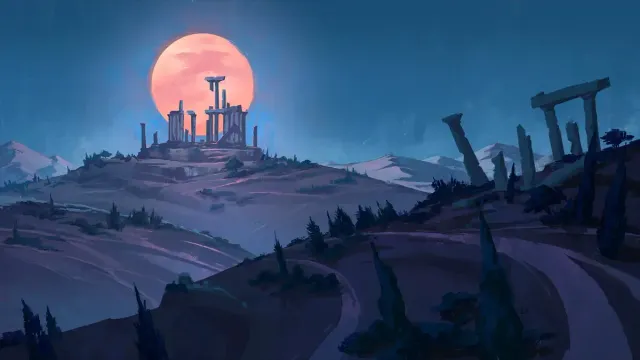
zombie worlds are out there, and they're terrifying places
It turns out there is life after stellar death. Say hello to zombie worlds, undead planets orbiting the most extreme objects in the universe.


You probably think you know what happens when a solar system is born. A spinning disk of gas and dust collapses on itself, gaining enough mass and pressure to fuse hydrogen into helium while the disk's orbiting leftovers form the planets as tiny perturbations add up over millions of years. When the star dies, so do its planets after either burnt to a crisp by its death throes, plunged into icy darkness, or obliterated by a supernova. But what if I were to tell you that sometimes, there is planetary life after a star's death?
Imagine a world born not out of a star's first scream, but from the agitated remnants of its corpse, a world rising from death and decay. Not only are they possible, but the very first planet we found outside of our solar system was exactly that: a zombie orbiting a neutron star after rising from the grave of the previous solar system. We still don't know exactly how common such odd planets are, but based on what we've seen, it's not a rare phenomenon. And these worlds could be some of the most bizarre and hostile environments in the universe.
Hold on a minute, how do we know these aren't just tough survivors of a supernova? Well, to put it bluntly, there's no such thing as a survivor of a supernova. Even a small one will vaporize literally anything with its raw energy. No mass of rock could ever withstand the blast wave. No advanced civilization can create a force field capable of deflecting the entire output of our Sun over 10 billion years, if not a thousand times more, hitting it in a single second. When a star explodes, everything within a dozen light years is irreversibly doomed.
of zombie planets and zombie stars
So, what would life by like on a world orbiting a neutron star? Kind of like attending a disco in the bowels of an exploding thermonuclear bomb. Pulsars and magnetars, the young and active versions of neutron stars, would constantly bombard them with radiation as they spun wildly around their own centers of mass. The sky would be illuminated by what looked like a strobe light if a pulsar beam hit it directly, or a pinpoint of light in the sky no larger than that a distant, alien sun, would flicker several times a second.
Either way, tsunamis of radiation would constantly hit the planet, sterilizing its surface, ripping apart its magnetosphere, and triggering unstable chemical reactions in what would be left of its atmosphere. Landing on a zombie world would be a massive challenge and trying to walk on one would be very ill advised. Outside of a few specific scenarios, life on a zombie planet would be impossible and its surface would be brutally cold since there would be no conventional light to consistently heat it like a normal sun would.
However, as just mentioned, there are possibilities in which zombie worlds could host life. The fist exoplanet ever found, a Super-Earth orbiting a pulsar designated PSR B1257+12, could very well be an example. It's four to five times as massive as our planet, is as close to the pulsar as we are to our sun, and if its atmosphere is a million times as thick as ours, the steady torrent of X-rays could produce just enough heat to support liquid water and life similar to the deepest, darkest, coldest trenches in our oceans.
when zombie planets orbit reality's end
All right, you may be wondering, if planets and life could exist around a neutron star, what about a black hole like in the movie Interstellar? Could two habitable planets exist around a literal tear in space and time? According to some research, it would be possible, but with a whole lot of caveats. It would need to be supermassive, large enough to affect entire galaxies with its heft. It would need to be actively consuming gas and dust, generating light and heat. Plus, the planet would need to be about ten light years away to form and survive.
Smaller black holes would be too small and cold to sustain any form of life on an orbiting world, and getting too close to one of any size means dealing with devastating tidal forces that distort the very fabric of reality as we know it. And while zombie planets orbiting a black hole wouldn't be constantly pelted with death rays, they would still be perfect targets during feeding time, as excess gas and dust heated to a billion degrees or so and channeled into a polar beam would be every bit as bad as straying within the blast zone of an active pulsar.
In short, the life of a zombie world is a precarious one, and they offer some of the most bizarre and challenging environments in the cosmos. Their extreme nature, which defies anything familiar and turns it on its head is what makes them so interesting, and the notion that they may still host life, as imagined by some Soviet sci-fi writers and deemed plausible by modern science, seems downright absurd. But they are yet another reminder that reality is stranger than fiction, and the universe is under no obligation to make sense to us.