how an artificial intelligence learned to understand the universe
For the first time, an AI was trained how to simulate a universe 600 million light years across. Does how fast it was able to do it and how well it understood its task tell us something profound about the cosmos?


As you can probably guess, simulating a universe takes a whole lot of time, effort, and energy. Just one large chunk of space as we know it takes hundreds of computational hours to render, and even after trillions of calculations it can still have an error rate of roughly 10% when its output is compared to real astronomical observations. In an effort to cut that time down, researchers turned to a new system called the Deep Density Displacement Model, or D3M, and gave it 8,000 simulations on which to train its understanding of the fundamental laws of physics and matter that underpin our existence. In other words, no big deal, just another day at the physics lab.
The result? D3M can render an entire universe in 30 milliseconds with a less than a 3% error rate, and it appears to predict the existence of dark matter and energy despite nothing in its training pointing to their presence. Certainly, this is a trial of both good modeling and math, but it does leave researchers a little stumped about how it seems to understand what happens to the universe if key parameters are tweaked. According to the study's co-author Shirley Ho, the result was "like teaching image recognition software with lots of pictures of cats and dogs, but then it's able to recognize elephants."
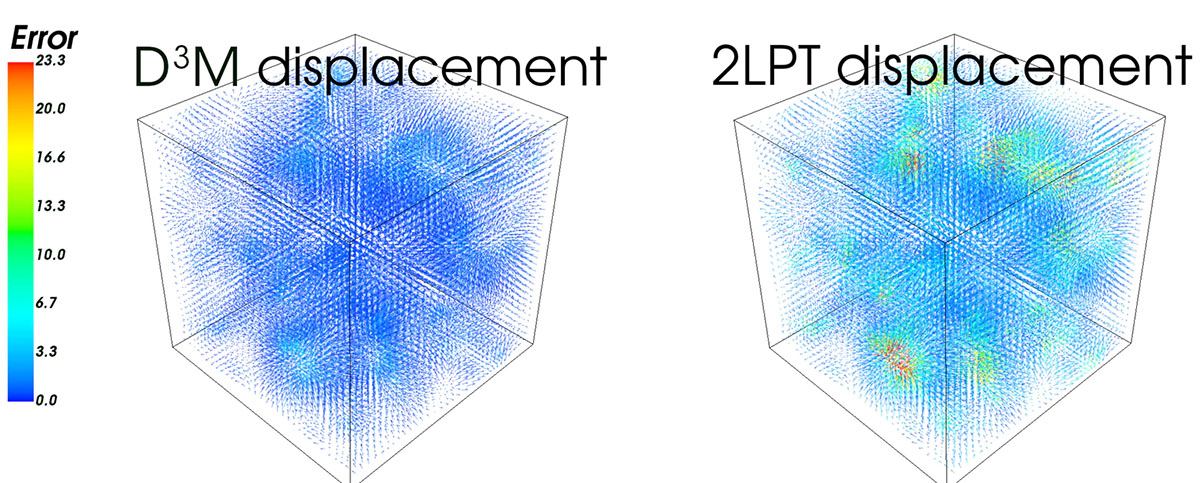
So, you may be wondering, how could D3M recognize elephants, to adopt to the analogy, and come up with such accurate predictions? There may be some clues if we consider how artificial neural networks work. They tend to zero in on the most relevant parts of a complex formula or system, which makes them both perfect for automating fuzzy logic and figuring out which components and factors are the most important. Maybe D3M found that given only a few basic aspects of the universe, behaviors and phenomena we don't fully understand are just emergent properties. It's not that we're overthinking astrophysics and need to radically simplify it, it's that we may have a much narrower list of culprits to pursue than we previously thought.
Considering that much of our understanding of the cosmos is based on mathematical formulas that build on each other, none of this shouldn't be that big of a surprise. But we also have to keep in mind that D3M is ultimately limited by our understanding as well. We are giving it our best guesses on how the universe works and it's boiling them down to the core concepts we need to explore further, but there's no way to know if we're getting the full picture. That said, however, the newfound a ability of artificial neural networks to model vast swaths of the universe is still very impressive and can give us a lot of clues has to where to direct our future research projects, D3M could signal a new dawn in modern cosmology.
See: He, S., et. al. (2019) Learning to predict the cosmological structure formation, PNAS, DOI: 10.1073/pnas.1821458116