when worlds collide: what happened the day the earth died
According to a new study, Earth's collision with a Mars-sized protoplanet 4.5 billion years ago didn't just create the Moon. It also gave us our oceans and helped life get started.


We're pretty sure we know that the Moon is the result of a collision with a Mars-sized rogue world we named Thea shortly after Earth was formed. But this event may have given us a lot more than a large, natural satellite. You see, because our planet was formed in the inner solar system, close to our parent star when it was at its hottest, it should've been a dry world, its atmosphere under constant siege by solar winds and any trace of water evaporated by the blazing hot, still forming crust. Our water must have come from somewhere else, somewhere in the outer solar system where comets, asteroids, and protoplanets were colder and wetter. And now we have evidence that may very well have happened.
One of the minerals we can study to understand the formation of Earth is molybdenum, which followed the migration of iron into the core and mantle of the planet. By itself, that's not all that meaningful until you note that there's still plenty of molybdenum in the crust, and that it's a different isotope than the ore from the planet's innards. To account for these observations would require that a whole lot of it came from an alien source somewhere from the outer solar system. Thea would be the perfect candidate to supply this mineral, and if it started off as a distant seed for a gas giant, it would've also had plenty of water which became the perfect environment for life to get started around energetic, nutrient-spewing volcanic vents.
When it collided with us 4.5 billion years ago, it would've deposited both over the course of a week, and while the molybdenum was trapped in the crust, unable to move towards the iron rich mantle and core, the water helped create our oceans. Of course, you may be wondering something that turns to steam at a paltry 100 °C could survive the inferno of two worlds smashing into each other. One way is by being trapped in water-rich minerals that can survive the event. The other is by becoming a shroud of vapor in close orbit around the result of the collision, then essentially raining back down as the planet underneath cools enough for it to turn back into a liquid, creating oceans and seas, and starting a water cycle.
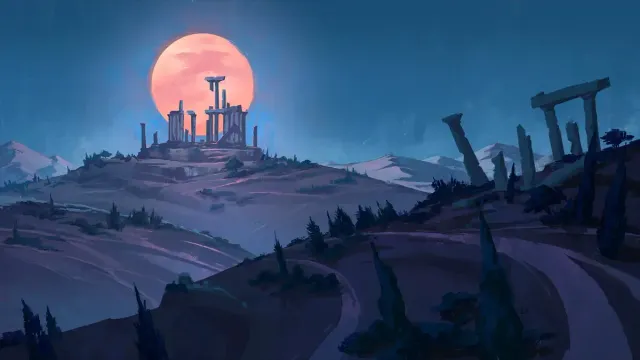
So, imagine if you will, an impact between two worlds which lasts over the span of several days, since we're talking about 6.6 septillion tons of rock and metal careening into each other as fast as bullets and energy is going to take a little while to propagate through all that mass, and then millennia of rain as the Earth finally cools enough to allow vast clouds of water vapor to change states. The world would've been blown apart, set on fire, reconstituted, then flooded. And with the newborn, red hot, glowing Moon looming in the sky more than ten times closer than it is today, every tide would've been like the rush of a tsunami. And out of this absolutely hellish environment, things managed to settle just enough for life to have a fighting chance to form out of the organic chemicals scattered around shallow seas and stirred by waves and tides.
While there are still uncertainties about exactly how much water Earth would've had before Thea slammed into it and exactly how much water Thea would've had, we do know that such collisions should happen relatively often in young solar systems. We've even seen the debris from such an event when looking for exoplanets around new stars. We might never know the exact details of how our planet came to be the way it was, the giant impact hypothesis certainly seems to answer a lot of questions and account for a lot of observations of our own world's geologic and fossil history and lunar chemistry and geology, while staying firmly in the realm of plausibility. And this study of the differences in Earth's molybdenum just adds another point of support for its models.
See: Budde, G., et. al. (2019) Molybdenum isotopic evidence for the late accretion of outer Solar System material to Earth, Nature Astronomy, DOI: 10.1038/s41550-019-0779-y