my neighbor, the supermassive black hole
What would really happen to Earth if we put the universe's most massive black hole on our stellar doorstep as a viral graphic imagines?


It all started with a post on Threads in which I was trying to debunk a viral graphic that claimed we would be treated to a spectacular view of the black hole's accretion disk if we replaced our nearest stellar neighbor Proxima Centauri – a red dwarf just a smidge over four light years away – with the supermassive black hole TON 618. Because we wouldn't. Not even close. And despite this being pretty easy to deduce with just a little math, scientifically illiterate but pretty engagement bait still proliferates.
First and foremost, despite being a black hole that weighs in at 66 billion solar masses, TON 618 is one of the brightest objects we've seen, shining 100 trillion times brighter than the Sun. It's not the brightest. That title belongs to quasar J059-4351, which is five times brighter than that. It also isn't called TON just because it's heavy, but because it's named after the Tonantzintla Observatory in Mexico, which first recoded evidence of it in 1957.
Hold on, hold on. How is a black hole, an object named after the fact that even light cannot escape its gravitational pull, be as bright as 20 billion Jupiters worth of light bulbs? Well, as its gravity pulls in gas and dust around it, the material accelerates to nearly the speed of light as it gets closer and closer, heating up to millions of degrees and glowing with every kind of radiation you can think of.
On top of that, black holes don't eat neatly. The accretion disk falling into it can't fall in fast enough, so it backs up, explodes, or falls into magnetic fields and gets blasted out by polar jets as death rays with powerful shockwaves. If a black hole was a person at a dinner table, it would be trying to consume a grocery store full of food while trying to set a speed record, constantly belching and making an epic mess as it flails when trying to shovel the calories into its maw.
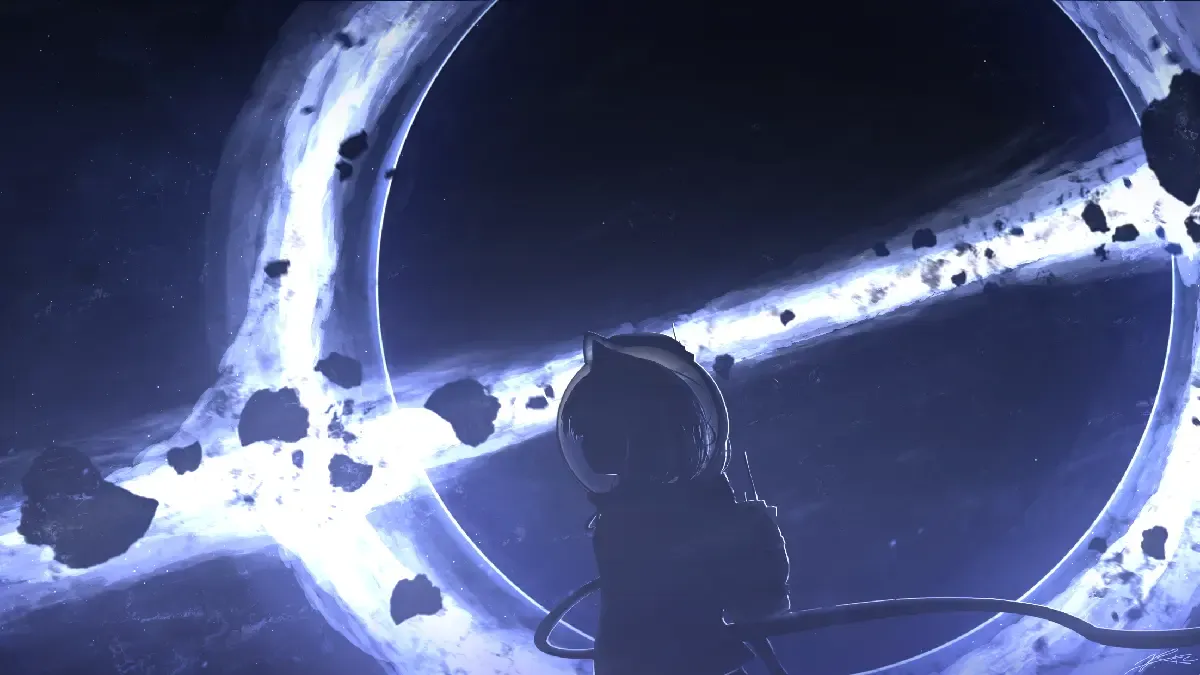
So, even several light years away, TON 618's light would be blinding. Rather than seeing a cinematic accretion disk across a fifth of the sky, all we'd see is a flash of brilliant white as gamma rays and high speed particles rapidly strip away our atmosphere and sterilize the planet down to the deepest biosphere hidden in the darkest, most remote crevices of rock. Oceans would boil away. Earth would be a more or less dead, airless rock burned to a cinder within 24 hours when you take its rotation into account.
It would be like being pelted by the shockwave of a supernova, but unlike your run of the mill dying star, the blast of radiation wouldn't end after 30,000 years. TON 618 will be around for so long, any measure of time would just be meaningless. For all intents and purposes, this blast furnace will last forever. Or, if we want to get pedantic, until the universe unravels, or whatever happens to the cosmos since we're kinda rethinking our models of it thanks to JWST.
Maybe if we were about 500 or more light years away we'd get a really cool star in the sky and elevated levels of radiation that won't be immediately lethal to all life. But if it's within the 25 light year supernova kill zone, we're cooked, literally. TON 618 is a system with far too much energy, far too much gravity, and far too large to take lightly. Just consider that Milky Way's Sagittarius A* is "only" 4 million solar masses, so wherever TON 618 ends up becomes the de facto new core of the galaxy.
But that does prompt an interesting question. How close can we put this giant to Earth for the planet to still exist? Running the math for the closest innermost orbit gives us 585 billion kilometers, or 3,900 AU, somewhere around the start of the Oort Cloud if we replaced the sun with this monster. Earth's surface would likely be liquid, superheated lava venting plasma into space, but it would still technically exist. Assuming, of course, that there's no accretion disk in this scenario.
Okay, so what's the farthest orbit we could have from TON 618? That's a much more complicated answer because there's essentially no such thing as the farthest possible orbit. All things are attracted to each other by the very topology of space, hence the gravitational constant G in all our space-time equations, and every body in a system orbits a common center of all their masses.
Earth could theoretically orbit a supermassive black hole a million light years away. It's just that other massive bodies closer would dictate its orbital mechanics instead because their gravity wells will have more sway than the black hole's. Both bodies would still feel the influence of the black hole, but again, that all depends on the distance between them, and there's no agreed upon cutoff point where the pull is too small to count. Even G at 667 billionths of a newton matters enough to include in our calculations at the scales in question.
Now, I know I pummeled you with a lot of numbers and apocalyptic imagery, but the real question is why? Why even bother debunking engagement bait that goes viral? There's always going to be misinformation, bad science, and stupid takes. It takes a lot of effort and math to correct. Why not just ignore it and let people stay misinformed if they want to, or do their own research and debunk it themselves?
Unfortunately, as we've seen today, algorithms have trained too may people to be passive consumers, so you need to offer alternatives to woefully incorrect but pretty bullshit designed to go viral. But even more importantly, because the actual science is so much weirder, cooler, and more amazing than any of the viral pop sci spam and slop will ever be. We are constrained by our imaginations. Nature is not. And I think it's way more fun to marvel at nature's weirdness and scale than brain farts of viral content farms.